
Penal means relating to punishment, especially under criminal law. In the US, it commonly describes laws, codes, and sanctions that define offenses and establish penalties. One adjective carries the whole idea of punishment in American law, and penal is the one. Lawyers put it in front of another noun, rarely on its own.
It marks the statutes that define crimes and fix what a court may do about them. Here is what the word covers, how a state criminal code is built, and how to cite a section without guessing. In plain terms, the word means relating to punishment.
A statute described that way defines an offence and states the punishment a court may impose. It traces back to the Latin poena, meaning penalty. So a state’s criminal code is simply the book of crimes and the punishments attached to them, gathered in one place.
Key Takeaways
- It is an adjective meaning “relating to punishment”, and it never stands alone as a noun.
- A state’s criminal code lists offenses, grades them, and sets a sentencing range for each grade.
- Washington keeps no book by that name, so federal crimes sit in Title 18 of the US Code.
- New York calls its version a Law. California and Texas both call theirs a Code.
- A citation reads jurisdiction, then the name of the code, then the section symbol, then the number.
- On a surety bond, the same adjective describes a dollar ceiling, not a premium.
What a Penal Code Actually Contains
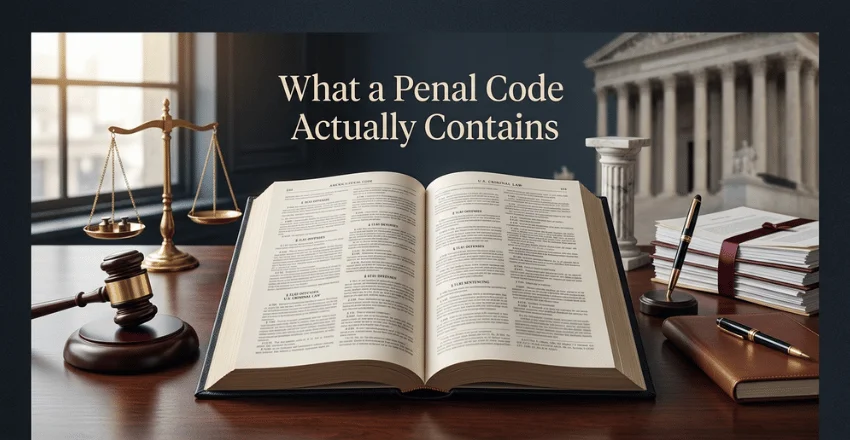
Open any state’s penal code, and you’ll find five key building blocks: definitions, offenses, grading, sentencing, and defenses. Knowing this layout helps lawyers quickly find the rules they need.
Table 1: the five structural parts of a state criminal code
| General provisions | Defines shared terms and mental states | Knowingly, recklessly, criminal negligence |
| Offense definitions | Lists the elements a prosecutor must prove | Burglary needs entry plus intent to commit a crime inside |
| Grading | Sorts each offense into a class or a degree | First degree felony, Class B misdemeanor |
| Sentencing ranges | Sets the prison term and fine each grade carries | 2 to 20 years for a second degree felony in Texas |
| Defenses | Spells out justification and excuse | Self-defense, duress, insanity |
Civil statutes work nothing like this. They tell you who owes whom money and how to sue for it. Criminal statutes speak for the state instead, and the sanction is a fine paid to the government, probation, or a cell. Our guides to criminal law charges walk through how those elements get proved in a real case.
Where the Word Comes From
English borrowed it through Anglo-French in the 1400s. Its root is the Latin poena, which meant a fine or a punishment. That same root gave us penalty, penalize, and repentance. Notice how each of those words points to a consequence rather than to a rule. Modern usage stays narrow. You will see it attached to a code, a law, an institution, a colony, or a sum. Outside those pairings, it sounds archaic, and most American lawyers say criminal instead.
Felony and Misdemeanor Classes, and the Time They Carry
Grading matters more than the label on the book, because grading decides the sentence. Felonies carry more than one year of imprisonment. Misdemeanors carry a year or less. Infractions carry no jail at all, only a fine and sometimes a court fee. We break this down further in Premises Liability Lawyer.
Sentencing ranges come from the legislature, not from the judge. According to the Texas Legislature, Section 12.32 of the Texas criminal code sets a first-degree felony at 5 years to 99 years in prison. A fine of up to $10,000 can follow. Compare that with a third-degree felony, which stops at 10 years.
How three big states grade felonies
Table 2: felony grading and general fine ceilings in three states
| New York | Class A-I, A-II, B, C, D and E | Life | $5,000 or double the defendant’s gain |
| California | No letter classes, a low, middle and high term written into each crime | Life without parole | Often $10,000 where the statute sets none |
| Texas | Capital, first, second, and third degree, plus state jail | 99 years or life | $10,000 |
Three states, three grading systems, one country.
That is why a sentence you read about elsewhere tells you very little about your own case. A charge that sounds identical can carry twice the exposure across a state line. Check the grade in the state where the case was filed.
Why New York, California and Texas Name Their Codes Differently
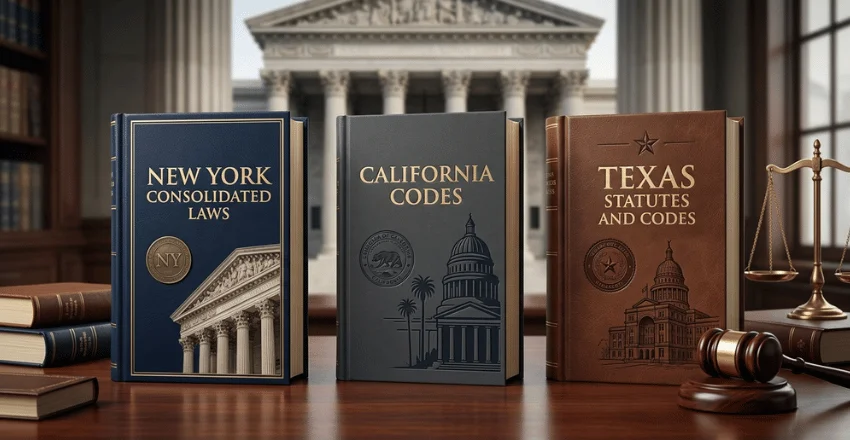
Naming is history, not logic. New York rebuilt its criminal statutes in 1965 and kept calling the result a Law, a label it has used since 1881. California adopted a Code in 1872, during the codification movement that swept the country after the Civil War. Texas followed the same path and rewrote its version in 1974.
Other states skipped the term altogether. Ohio folds crimes into a Revised Code. Illinois uses a Criminal Code, and Virginia buries the subject inside a numbered title of its statutes. What the drafters called the book tells you nothing about severity.
How to Read and Cite a Section Number
Citations look cryptic until you see the pattern. Read them left to right. Five pieces show up, in the same order every time.
- Jurisdiction: Cal., N.Y., Tex., or whatever abbreviation your court prefers.
- Name of the code: the title of the book the offense lives in.
- Section symbol: one symbol for a single section, two for a range.
- Number: the chapter and the section, usually split by a period.
- Subdivision: the lettered or numbered piece that holds your rule.
Take Section 12.32 again.
It’s 12 points in the chapter on punishments. It’s 32 points in one section inside that chapter. Add a subdivision letter, and you have aimed a judge at a single sentence.
Numbers get reused across state lines, so never quote a section without naming the state. Section 187 means murder in California. In New York, those digits mean nothing at all.
Criminal Punishment Statutes vs Civil Lawsuits
One act can trigger both, and people mix the two up constantly. A prosecutor brings the criminal case for the state and asks for prison or a fine. A private plaintiff brings the civil case and asks for money damages. Different burdens of proof apply, so a defendant can lose one case and win the other.
Assault shows that split clearly. The state may charge it under its criminal code while the injured person sues separately for medical bills and lost wages. An assault defense lawyer handles the first case. A personal injury attorney handles the second.
What a Penal Sum Means on a Surety Bond

Here, the adjective leaves criminal law entirely. On a bond, that sum is the maximum figure the surety will pay if the principal fails to perform. Think ceiling, not premium, and certainly not deposit. A contractor who buys a $500,000 performance bond usually pays a small percentage of that figure as the premium.
Bail works on the same idea. Whatever amount appears on the bond is the ceiling a court can collect if the defendant skips. Confusing that ceiling with the cash a family actually hands over ranks among the most common mistakes in bond paperwork.
Where to Go From Here
Start with the grade, never with the label. Look the offence up in your own state’s statutes, note its class, then read the sentencing range that class carries. Those three steps tell you more about real exposure than any general article can. If a charge is already filed, find a lawyer in your state before you discuss the facts with anyone else.
Frequently Asked Questions
An adjective, always. Say “criminal code” or “criminal statute” when you need a noun, because the word itself has to modify something else.
Not under that name. Federal crimes live in Title 18 of the US Code, which covers offenses such as mail fraud, bank robbery, and tax evasion. State courts handle the overwhelming majority of ordinary prosecutions.
One defines crimes and their punishments. The other sets the rules a case follows, covering arrest, charging, discovery, and trial. Most states publish them as separate books.
Yes, and legislatures do it every session. Lawmakers add offenses, raise or lower grades, and sometimes decriminalize conduct outright. Marijuana rules have moved fastest of all, which is why an offence from 2010 may not exist today.
It raises the grade or the punishment because of an extra fact, such as a prior conviction or a weapon. The code itself spells out every enhancement. No judge invents one.