


You hit it in an indictment, a deed, or an old contract, and it stopped you cold. Lawyers have leaned on to wit for roughly six centuries, and it still turns up in American filings. This guide covers what the phrase does, how to punctuate it, and what to write instead.
Short answer: In legal writing, to wit means “namely” or “that is to say.” It introduces the exact item that a broader description covers. An indictment names possession, then the precise drug. A deed grants land, then the precise boundary. The words after it are the specifics, and they control.
Key Takeaways
- The phrase is a pointer. It says “here comes the specific.”
- It is not Latin. The root is the Old English verb witan, meaning to know.
- Standard American style prints it as two words, with a comma before it.
- Plain-language drafters delete it. “Namely” or a bare colon does the same job.
- In a charging document, the words that follow narrow the accusation. Read them closely.
The Phrase at a Glance
| Question | Short answer |
|---|---|
| Meaning | Namely; that is to say; specifically |
| Origin | Old English witan, “to know,” by way of Middle English |
| Age in English law | Standard in pleadings by the 1400s, doing the work of the Latin scilicet |
| Standard spelling | Two words. The hyphenated “to-wit” is a court-clerk habit, not a rule |
| Punctuation | Comma before. Comma or colon after |
| Pronunciation | “too wit.” The second word rhymes with “sit” |
| Plain substitute | Namely, specifically, or a bare colon |
| Still current? | Yes in indictments and deeds. Rare in new contracts |
What the Phrase Actually Does

Think of it as a grammatical arrow. On the left sits a general term. On the right sits the particular the writer has in mind. That tag joins them and promises the second is an instance of the first.
According to the Legal Information Institute at Cornell Law School, the phrase introduces examples for a more general statement. Its entry on the term quotes the Supreme Court using it exactly that way, some 600 years after English clerks first wrote it into pleadings.
That is the whole job. The tag carries no meaning of its own, which is exactly why plain-language drafters keep deleting it. For a closer look, see Absentia Meaning Explained.
Where the Word Comes From
Here is the surprise. Despite the courtroom smell, it isn’t Latin at all. “Wit” here is the Old English verb witan, meaning to know or to be aware of. That same root gives us “witness,” someone who knows, and “unwittingly,” without knowing.
So the literal sense is closer to “that you may know.” A clerk in the 1400s writing it meant something like: here is what you need to know, precisely. Say it out loud as “too wit.” The second syllable rhymes with “sit,” and none of it relates to humor.
Where To Wit Still Turns Up in Legal Documents
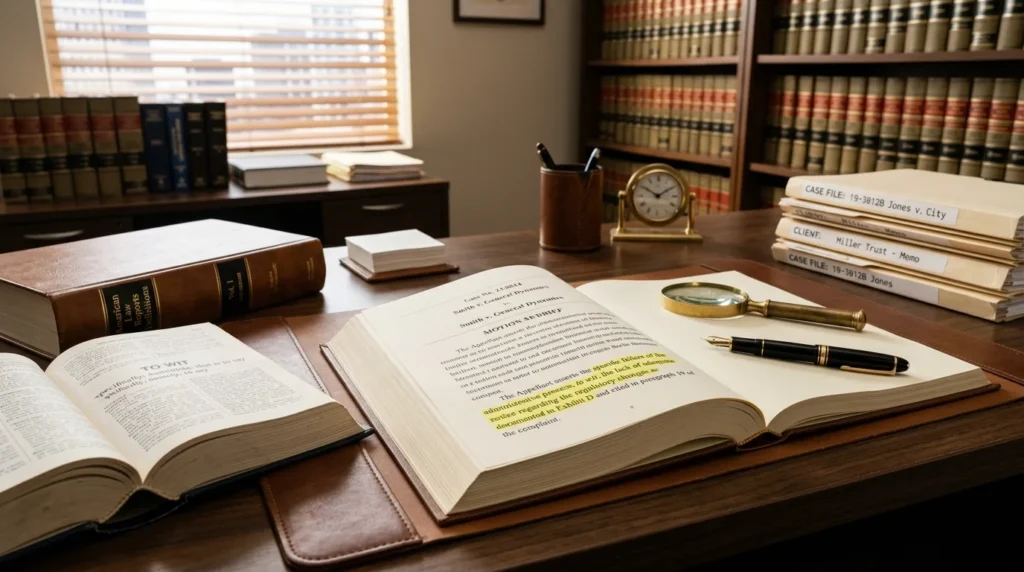
Four settings keep it alive in American practice.
- Indictments and charging documents. A count states the offense in statutory language, then names the particular. “Possession of a controlled substance, to wit: cocaine.” That specificity is what gives a defendant constitutional notice of the accusation against him.
- Deeds and legal descriptions. A grant of land is followed by the metes and bounds that fix its edges.
- Affidavits and notary jurats. Older forms use it to introduce the county or the sworn fact.
- Legacy contracts and schedules. A clause promises equipment and then lists the specific machines.
Criminal filings are where most readers meet it, because charging language is the most conservative writing in the whole system. Our criminal law explainers walk through how a criminal count gets assembled. Deeds run a close second.
Comma, Colon, or Both?
Sources disagree here, which is why the question keeps getting asked. Cornell’s entry says a colon usually separates the tag from what follows. Most drafting guides call for a comma before and a colon after. Court clerks often put a comma on both sides.
All three are defensible, and one rule reconciles them. What comes before is always a comma. What comes after depends on length: a single named item takes a comma, while a list or anything holding internal commas takes a colon.
Both of these are correct:
- The defendant committed theft of a firearm, to wit, a Ruger LCP.
- The equipment transfers, to wit: two forklifts, one baler, and a pallet jack.
What fails is the bare tag with no punctuation at all. Doubling it with “the following” fails too. “As follows, namely” says one thing twice, and readers notice.
Hyphen or No Hyphen?
Both spellings run loose in the wild, and the usual sources skip the question, so here it is plainly. Dictionaries and Black’s Law Dictionary print the two-word form. In edited American prose, that is the correct spelling, every time.
The hyphenated “to-wit” survives almost entirely inside charging documents, where it nearly always carries a colon. Treat it as a clerical convention of that one genre of filings. Copy it if you are matching a local form book. Everywhere else, two words.
Namely, Specifically, I.e.: Which One Do You Want?
These are near neighbors rather than twins. Choose by what the second half of your sentence is doing.
| Word | What it signals | Reach for it when |
|---|---|---|
| Namely | The complete set of what the general term covers | Nearly always. This is the plain replacement |
| Specifically | Narrowing to one item, not necessarily the full set | You want weight on the particular |
| i.e. | Restating the same thing in different words | The second phrase equals the first |
| e.g. | Examples only, and the list stays open | You mean “such as,” never a closed set |
| viz. | Latin videlicet, the direct ancestor | Almost never. Archaic in American writing |
| The old tag | Same as “namely,” plus six centuries of courtroom dust | Quoting a statute, a form book, or an indictment |
One mistake matters more than the rest. Writing “e.g.” where you meant a closed list turns a fixed set of obligations into an open one, and that is a real difference in a contract.
The Trap: It Narrows What You Alleged
Here is the part most definition pages skip. Words that follow the tag are not decoration. They limit the pleading to the thing named.
Allege “assault with a deadly weapon, to wit: a knife,” and you have told the court and the defendant that the weapon was a knife. Prove a tire iron instead, and there is now a variance between the pleading and the proof. Whether that variance sinks the count turns on the jurisdiction, and on whether the defendant was genuinely misled. It is rarely fatal. It is always an argument the defense gets to make.
Deeds run on the same logic. A description that names a parcel controls over the looser grant preceding it. Precision is the entire point. That is also the strongest case for keeping the old formula where notice is the whole game.
Why It Survived This Long
Three forces kept the phrase in the language. Form books get copied rather than rewritten, so a clause drafted in 1890 can land in a filing in 2026. Courts blessed the older wording, and blessed wording feels safe. Precision also carries real value in an indictment, where vagueness gets counts thrown out.
None of that argues for using it in a lease. It does explain why the term will outlive every article telling attorneys to drop it.
Should You Still Write It?
For most drafting, no. Black’s Law Dictionary labels the phrase as archaic, and the plain-language movement has spent decades removing this kind of wording from public documents. The Plain Writing Act of 2010 pushed federal agencies down the same road. Your reader gains nothing from the tag.
Deleting it is usually a one-word edit. Sometimes the whole construction goes, and a colon carries the load by itself.
| Archaic clause | Plain rewrite |
|---|---|
| Lessee shall maintain the equipment, to wit: the compressor and the chiller. | Lessee shall maintain the compressor and the chiller. |
| Seller conveys the property, to wit, Lot 14 of the Harbor Tract. | Seller conveys Lot 14 of the Harbor Tract. |
| The parties agree as follows, to-wit: | The parties agree: |
Look at what happened in each row. The general term was pulling no weight, so it left alongside the tag. Commercial drafting has moved this way for years, and our business law coverage tracks how contract language keeps getting shorter. Keep the archaic form only when you are quoting a statute or filling in a court’s own template.
How to Read It in Your Own Paperwork
Say you are holding a charging document or a deed and want to decode the thing without a law degree. Work in this order.
- Find the general phrase sitting just before the tag. That is the legal category.
- Read every word that comes after it. That is what the government or the grantor actually claims.
- Compare the two. If the specific does not fit the category, you have found something to ask about.
Step three is where a non-lawyer reading his own file finds real problems. A statute may cover “a deadly weapon” while the object named is an ordinary hand tool. Ask the question anyway.
Where to Go Next
Vocabulary is the easy part. Working out what a document does to you is the harder part, and that question deserves a real conversation with an attorney who handles such matters. For more plain-English breakdowns of the terms that fill American filings, browse our plain-English legal explainers.
Frequently Asked Questions
Yes, mostly in charging documents and deeds. Modern contract drafting has largely dropped it. You will meet the phrase as a reader far more often than you will ever need to write it.
Effectively, yes. “Namely” is the plain-English equivalent, and it fits almost every sentence where the older tag appears.
No. Its root is the Old English verb witan. The Latin cousin is videlicet, shortened to “viz.,” which does the identical job.
A comma before, then a comma for a single item or a colon for a list. Both patterns are common in filed documents.
Usually. Read the sentence without it. If the meaning survives, and it nearly always does, leave the tag out.